
Vancouver Back-to-School Declutter: Removing Summer Activity Gear and Creating Study-Ready Spaces for Students
Drowning in summer sports gear and wondering how to transform chaotic spaces into organized study zones before school starts? Vancouver families can leverage the city’s extensive recycling infrastructure and proven decluttering strategies to create calm, productive environments that actually boost student performance and reduce family stress.
The transition from lazy summer days to structured academic schedules hits Vancouver families like a tidal wave every September. After months of accumulating camping gear, sports equipment, art supplies, and seasonal toys, homes often resemble storage units more than living spaces. Research from Yale University reveals that visual clutter literally alters how information flows through the brain’s primary visual cortex, making concentration significantly harder for students trying to focus on homework and study sessions. This isn’t just about aesthetics—it’s about creating environments that actively support academic success.
Vancouver’s unique combination of outdoor lifestyle and compact housing creates specific decluttering challenges that generic organization advice doesn’t address. Families need strategies that work within the city’s recycling infrastructure, donation networks, and space constraints. The good news is that Metro Vancouver offers some of North America’s most comprehensive disposal and donation options, from specialized sports equipment diversion programs to extensive charitable networks specifically serving children and families in need.
This comprehensive guide walks Vancouver families through every aspect of back-to-school decluttering, from removing accumulated summer gear to creating study spaces that genuinely improve student performance. We’ll explore when to tackle different areas, how to leverage Vancouver’s disposal infrastructure, and whether professional junk removal services make financial sense compared to DIY approaches. Most importantly, we’ll show how strategic decluttering before school starts sets up sustainable organization systems that reduce stress throughout the academic year.
Key Outtakes:
- Decluttered study spaces can improve student focus and academic performance by reducing cognitive load and visual distractions
- Vancouver offers extensive recycling and donation infrastructure including the Zero Waste Centre and specialized sports equipment diversion programs
- Professional junk removal services can recycle up to 60% of items while saving families time and reducing injury risks
- Strategic seasonal decluttering before school starts creates healthier routines and reduces stress throughout the academic year
- Proper organization systems with designated zones and visual cues enable children to maintain tidy spaces independently
Why Back-to-School Decluttering Matters for Vancouver Families
The connection between organized environments and student success runs deeper than most parents realize, with solid research backing up what many families intuitively understand. A groundbreaking 2024 study from Yale University demonstrated that visual clutter fundamentally alters information flow through the brain’s primary visual cortex, directly reducing students’ ability to concentrate on homework, reading, and test preparation. This neurological impact means that cluttered bedrooms and study areas aren’t just aesthetically unpleasing—they’re actively working against academic performance by hijacking attention from important tasks.

The physiological effects of clutter extend beyond concentration difficulties into actual stress responses that affect the entire family. UCLA researchers found that people living in cluttered homes showed elevated cortisol levels—the primary stress hormone—compared to those in organized spaces. For Vancouver families already managing the pressures of academic schedules, extracurricular activities, and urban living costs, eliminating clutter-induced stress becomes a crucial component of overall family wellbeing. Children studying in chaotic environments experience measurable increases in stress that can interfere with memory formation, sleep quality, and emotional regulation.
Back-to-school season presents a unique opportunity that organizational experts consistently identify as optimal timing for comprehensive decluttering projects. Unlike spring cleaning, which often gets postponed due to weather or competing priorities, pre-school-year organizing benefits from natural motivation and clear deadlines. The transition period allows families to assess what accumulated over summer months, identify items children have outgrown, and create fresh systems before academic pressure begins. Research shows that Americans spend 2.5 days annually searching for misplaced items, which translates to 150 days over a lifetime—time that organized families can redirect toward more meaningful activities.
Removing Summer Activity Gear: Sports Equipment and Seasonal Items
After months of summer camps, outdoor adventures, and seasonal activities, Vancouver homes often overflow with sports equipment that ranges from actively used to completely forgotten. The key to effective gear removal lies in understanding that fall represents the natural transition point for evaluating seasonal items before they disappear into storage areas for eight months. Professional organizers consistently recommend early fall as optimal timing for this assessment because weather conditions remain comfortable for garage and outdoor storage sorting, while memories of summer activities remain fresh enough to make informed decisions about each item’s utility.
The systematic approach to summer gear removal begins with category-based sorting that reveals the full scope of accumulated items. Rather than randomly selecting items from different storage areas, families should gather all sports equipment in one location—every baseball glove, soccer ball, camping chair, and pool toy. This visual inventory often surprises parents with quantities they hadn’t realized accumulated. The “one-year rule” provides objective criteria for decision-making: if your child hasn’t used specific equipment in the past year, they’re unlikely to use it next summer, especially considering how rapidly children’s interests and abilities evolve.
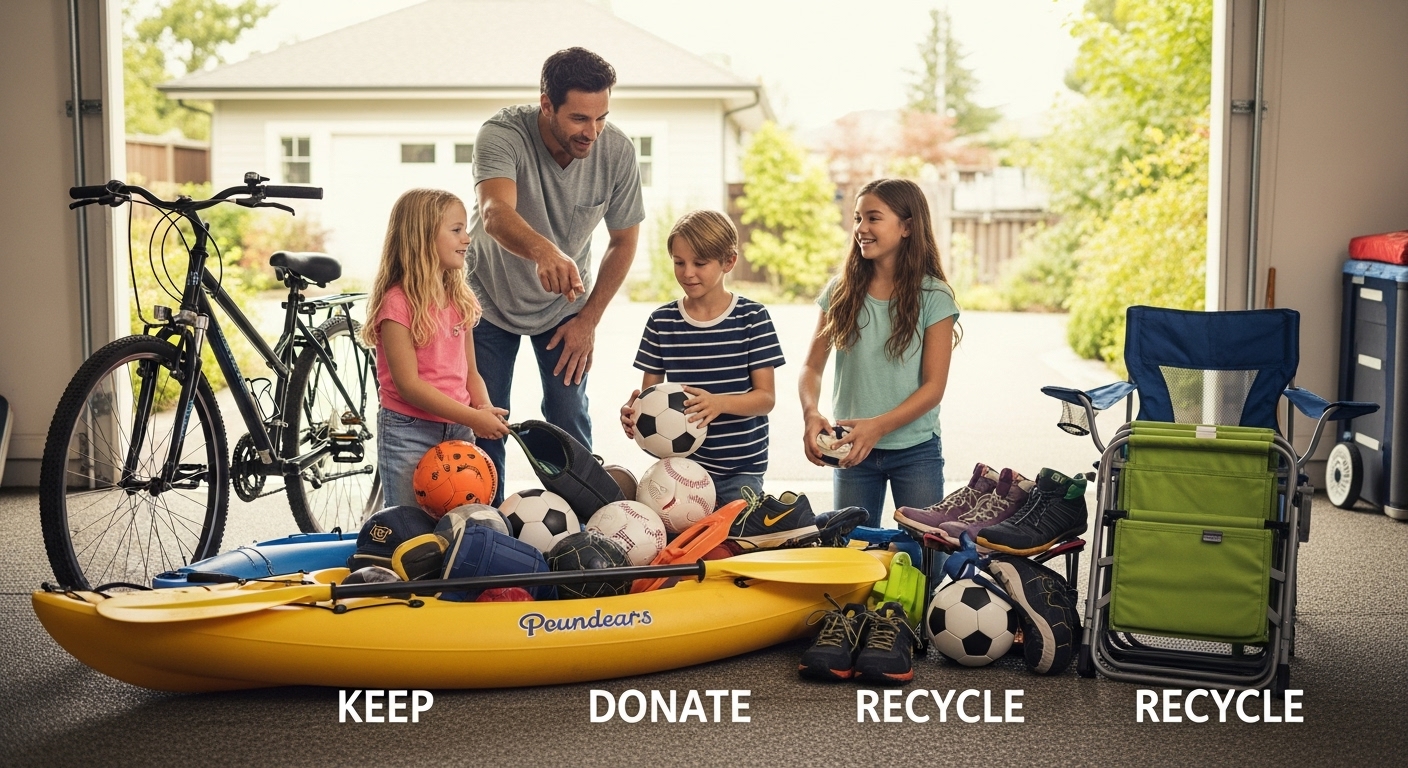
Vancouver’s specialized sports equipment disposal infrastructure makes responsible removal remarkably accessible through programs that most families don’t know exist. Project Re-Bounce operates at over 15 locations across the Lower Mainland, Victoria, Sunshine Coast, Squamish, and BC interior, specifically targeting end-of-life sporting goods. The program accepts tennis balls, squash balls, pickleball balls, and athletic shoes, with donation-quality items routed to Downtown Eastside support organizations while beyond-donation items go to Metro Vancouver’s Burnaby Waste-to-Energy facility rather than landfills. This specialized service eliminates the common problem of families keeping unusable sports equipment because they don’t know how to dispose of it responsibly.
Creating sustainable storage systems for equipment that children will use again requires strategic space allocation that acknowledges seasonal rotation needs. Rather than allowing sports gear to colonize entire garages or storage areas year-round, Vancouver families can implement designated zones with defined capacity limits. Summer items move to long-term storage areas during fall, while fall/winter gear becomes accessible. This rotation system works particularly well in Vancouver’s compact housing where every square foot carries value. The spatial limitation inherently forces decision-making—when the designated summer storage area reaches capacity, families must choose what truly deserves space versus what should be donated.
The timing of this seasonal transition also provides natural twice-yearly review points that prevent long-term hoarding without requiring constant vigilance. When families consistently evaluate gear at summer-to-fall and winter-to-summer transitions, items don’t accumulate beyond useful quantities. Children’s rapid growth and changing interests mean that equipment suitable for a 10-year-old may be inappropriate for the same child at 12, making regular evaluation essential rather than optional for families serious about maintaining organized spaces.
Children’s Room and Playroom Cleanout Strategies
The most effective approach to children’s room decluttering involves what professional organizers call the “blank canvas method”—completely emptying the room to disrupt the brain’s habituation to clutter and force active decision-making about every item’s return. While this intensive approach requires significant upfront effort, it produces dramatically better results than gradual sorting because it breaks the psychological familiarity that makes families overlook obvious excess. When items that have sat unnoticed in corners for months suddenly appear in the middle of a room, parents and children can evaluate them with fresh perspective rather than simply working around them as permanent fixtures.
The category-based sorting process that follows room emptying provides visual clarity about quantities that’s impossible to achieve when items remain scattered throughout spaces. Professional organizers consistently recommend creating distinct piles of similar items—all building blocks together, all art supplies together, all stuffed animals together—because this approach reveals excess immediately. A child might have 47 stuffed animals but only regularly interact with 5-8 favorites, a reality that becomes obvious only when all stuffed animals appear in one pile. This visual representation helps families make objective decisions based on actual usage patterns rather than vague impressions about what children might want.
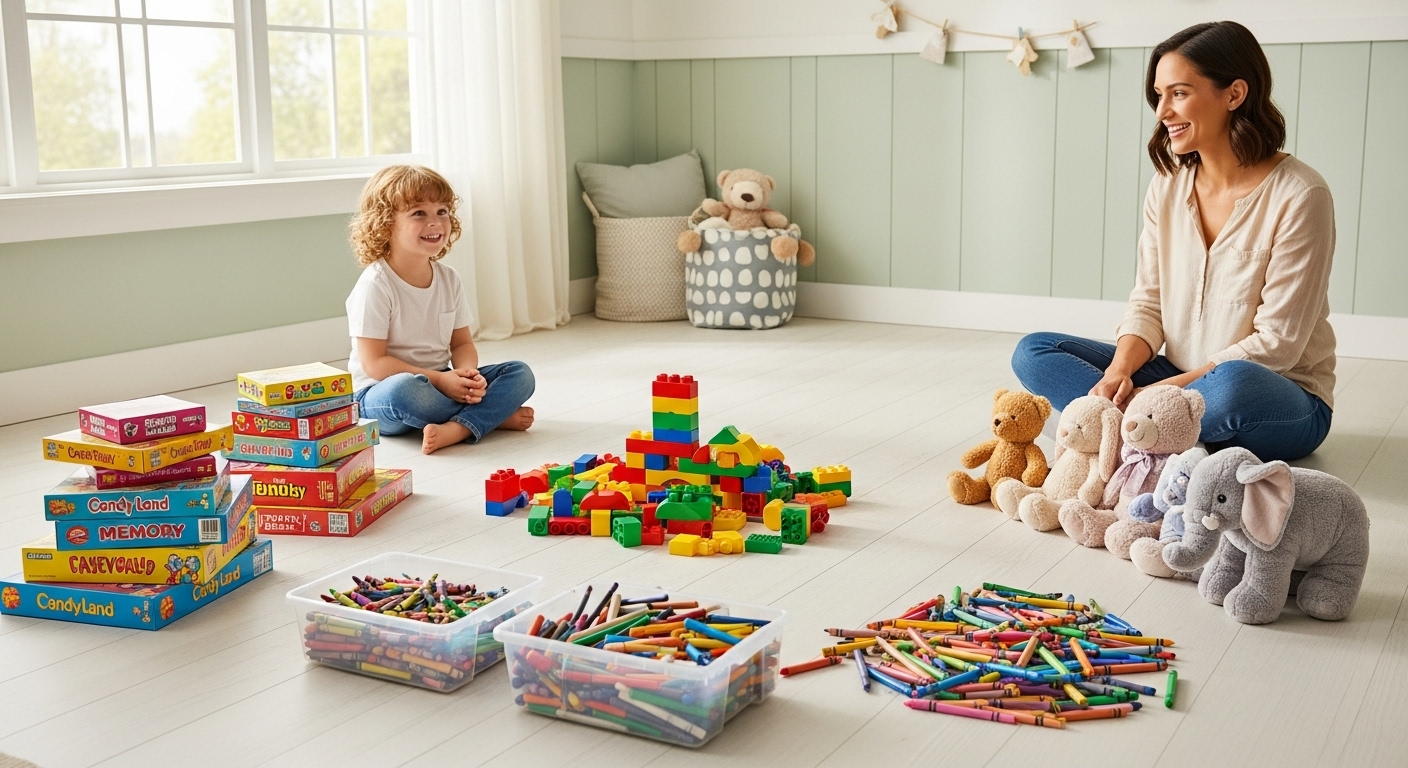
The decision-making framework that follows sorting requires clear criteria that cut through emotional attachment to items that no longer serve their purpose. Professional organizers recommend asking three questions about each item: “Is this something the child needs?”, “Do they still use it?”, and “Does it have special value?” Items that fail all three tests should be removed without exception, while those passing multiple tests return to the

